
A Hero's Return
armenians

“Hima hasnoumenk, brat;” George woke up from his sleep in such a terrible daze that the bus driver’s voice sounded like an alien transmission. He lifted his head from the window and looked out: the rains of last winter left the soil thick and waterlogged, but nevertheless the vineyards were blooming, and even the drab hills were covered in oleaster trees thick with blushing fruit. It will be festival soon— all the streets will be littered with plastic-covered tables, decorated with dried apricots and apples, and plastic-bottle’d wine, and there will be hot-red faces shouting along as the sweat poured from their brow. He stared at the fog formed by his breath on the window of the bus. He took a few minutes to collect himself. Though he’d dreaded coming home, George felt an odd sense of relief seeing his old school building again. His past had returned somehow, almost clear as it once was; it had dutifully waited for him. He’d left in a late autumn many years ago, when the vineyards were bare and without color. And he’d imagined returning in winter, in triumph, to a village locked in snow. He found that it was spring and everything had bloomed without him.
When the bus came to a stop and George pulled himself up by his arms to stand, the bus driver jumped out of his seat and ran towards George with his hands raised. “Brat,” the driver yelped, “let me help you!” And though he really was trying to be helpful, George couldn’t help but feel irritated by his unsolicited offer. “I’m fine! No need!” George answered as he pulled his suitcase down from the rack above his seat. The bus driver’s mouth gaped with awe as they stepped off the bus together. “We’re all so proud of you,” the bus driver said as George thanked him and shook his hand. “And tell your mother I said hello, Garik-jan.”
The road up to his mother’s home was steep, though not too far away. He looked around his old village; he was surrounded by tall walls on both sides, now renovated and painted tan. Development was uneven here, as it was in the rest of the villages. Some of the buildings looked like they’d been freshly carved out of stone, while others were skeletal remains of what the Soviets had built. Every street seemed chiseled with its own memories of Soviet times, the limbs of some ancient sleeping creature with tendrils of metal and baton which wheeze smoke and groan rust. And the path up the road was built with asphalt walkways and concrete stairs, crumbling at their base, boundaries marked by metal wire mesh and plastic trash. Oral history out here is made up of Soviet times and whatever came after. You can ask ‘Hagop-hopar’ down the magazin and he’ll tell you all about his childhood as a ‘Young Pioneer,’ watching the girls swim as they chewed on their blood-’n-chocolate wafers. He’d made this journey before, he’d done it many times, but now he felt pain course all throughout his body with every laborious step after another. It all seemed so terribly far away.
“Garik!’ a young woman came running down the road, raising an arm and shouting. The first thing George noticed were her Gucci slides, with bands of red and green under a plastic buckle. “Milena,” he answered with a faint groan. She ran to him and embraced him, her head barely reaching his shoulders. “How big you’ve gotten,” he gasped as she squeezed the air out of him, causing his suitcase to fall beside them on the street. She’d missed him; after he picked his suitcase back up, she held onto his arm and walked him home.
“He’s here, he’s here!” Milena shouted as she pulled George through the front door. “Gapik is here!” George felt apprehensive; the paint of the front door had changed and the rugs from the balcony were gone. The hallway was as dusty as it ever was. A few framed portraits sat beside dried pomegranates. He shut his eyes in anticipation, he’d always hated the welcome of large crowds; he opened his eyes and saw only his mother Lilit, standing at the television with an energy drink. She had a dull smile. He embraced his mother, feeling her body quiver in his arms. “I’m not going to say anything,” her voice muffled by his chest. “I’m not going to say anything or cry, I promise.” She’d told everyone George was coming tomorrow, to let him arrive home in peace. He was grateful.
When he broke away from his mother, she handed him the energy drink and dried her tears on her wrist; the kohl was running down her cheeks, grey and black like ash. “It’s good, have some,” Lilit said as she turned to Milena. “And look how big your cousin’s gotten,” she laughed. Milena jumped behind George, suddenly so shy, casting her eyes down as her face turned away from Lilit’s gaze. “She’s a woman now,” Lilit added. “And she wants to hear all about Moscow, and your adventures, and your…” Lilit looked at her son, his eyes glassy and red as he handed her the energy drink. “I’m so sorry, Gapik-mama,” Lilit stopped herself. “Why don’t you go upstairs, take a bath and rest? We’ll talk more tomorrow.”
Milena carried up George’s suitcase, grasping the handle with two hands; watching her go up from the back, George found it hard to recognize her. Though her body had grown into a desirable shape, and he thought of his mother’s disapproval as his eyes roamed, she swung and spun and sang like a child just as she’d done years ago when George would walk her to school. Right up the stairs, past the third door. Milena set the suitcase by the bed and watched as George took a seat on the edge, sighing as the bittersweet sensation of homecoming brought him at ease. George looked up at her as she stood quietly; seeing the sharp angles of her face, the intensity of her eyes, he’d realized she was grown now. She looked down at this legs. “Does it hurt?” Milena asked. “Sometimes,” George answered. “It’s okay, not too bad.” Milena’s soft smile slipped away. “Could you show me what it looks like?” she asked, rubbing her fingers.
George nodded. He reached down, undid the laces of his left boot, then took it off with his left hand while holding onto his ankle with the other. After letting the boot fall onto the floor with a fleshy thud, he removed the sock and revealed pliant, glossy plastic that bore only a superficial resemblance to flesh. Milena’s reaction surprised George; her brow rose with excitement, her mouth formed an excited ‘O.’ “I thought it would be wood for some reason,” she said while covering her mouth with her hand. “You can get one with wood, but this is better for people who move around a lot,” George answered. Milena smiled, then she set her arms behind her back and bowed; “I’m sorry for prying. I’ll let you rest now,” she yelped. She ran for the door; before shutting it behind her, she set her face to the gap between the door and the frame, and she spoke into the room with a private hush: “thank you for showing me that, George.” Then the door fell shut, leaving George alone in the dust of his old room.
George sat there for a while. He wasn’t sure how long, his old alarm clock wouldn’t budge anymore. He took off his right boot and got up on his feet. His room had not changed in the years he’d been gone, it had not even decayed. His football medals, his guitar, his posters of Maria Sharapova and his photographs— a portrait of his father rested beside a few books, his eyes dark and his face folding into itself. His father; it pained George to see him. That expression of his, moody and anxious, hung ‘round George’s neck like an anchor. Beside the portrait, a few frameless pictures sat collecting dust. He took one into his hands and he laughed; he hadn’t seen Alissa in so long that he’d forgotten her face, and he wondered if she was a blonde now, just like the girls from Moscow. Another photograph was of Garro and himself, standing shoulder-to-shoulder, kits covered in grass and mud.
Oh, Garro; sometimes he’d miss the many hours he’d spent playing football with Garro. Looking at the picture of the two of them together, George studied his own bygone face; he laughs at his own roundness, and the smile that seemed like it belonged to someone else. When he’d have his sleepless nights in Moscow, he always tried to imagine himself returning to his room. But in his imagination, the photographs were torn, blurry, covered in mud somehow. George was surprised to find that the photographs, the lost sensations they represented, the shape of those thoughts— they were as sharp as they’d ever been. He yawned and felt a pain in his hip. His shoulders had started to weigh unbearably heavy. He took the pictures to his bed, and after removing his feet and applying balm, he thought of the last time he’d seen Garro before falling asleep.
By the time the sun took to setting, most of the neighbors had already arrived, bearing gifts of chocolate and cognac, filling the garden with boisterous laughter and the clinking of shot glasses. Behind a family of white trees, wooden tables were dressed with large tan olives and pale cheeses, accompanied by burnt peppers and smoked meats; a few red lakes lay beside plastic soda bottles filled with cottage wine and brandy. George stood under the shade by the back door and watched their faces; sooty, full of holes, like the streets they live on. He tried to put names to the faces but they wouldn’t come willingly. Some of them might be considered Lilit’s close friends. There was Hasmik; she used to be a teacher before her son got sick from emphysema. Manouk and Elmira; they ran a bookstore back in Soviet times, they had a pretty daughter that left for Paris after her sixteenth. Hayko grew corn, he never married. Angelika— his mother said she looked like Sophia Loren in her prime. George poured himself a cup of wine from an old Coke bottle. Not many young people stayed behind in a village like this one, so all of his mother’s friends would be dressed in drab camouflage sweaters and antique corduroy. And their lips would be charred by Akhtamar cigarettes, their hands cracked and swollen. He saw his mother walking down a trail of stones to one of the tables, holding a large carafe filled with compote, filling glasses with a smile as each guest rambled ‘bout their chickens and trucks and what they’d seen today on their phones. Their smiles were taut, ungiving. “Be good and don’t leave yourself on my floor this time,” Lilit said with a laugh to Hayko as he poured himself another cup of cognac.
Lilit watched her son hiding under the shade. She smiled but she would not call out to him. She’d learned a long time ago to accept that he wasn’t the kind to talk about it. Maybe he pined for Moscow, its anonymity, how easily it could let a man forget himself and his responsibilities. On those wide, cold streets, he’d just be another hungry face— unburdened by the smothering concern of others. And as Hayko went on about his KAMAZ, she thought about how lonely it would feel to be the one sailor left alive on the shore, crawling among the wreckage. She thought of it a bit more and then forgot. Lilit smiled; she told Hayko that George was good with his hands and that she’d love to get him out of the house for a day.
“Yurik, is that you?” George was pulled away from his thoughts, sipping on his wine, when he’d heard the door open behind him with a chipper voice calling out his name. When he recognized the voice, he felt every muscle of his body freeze with indecision. “Yooo-rik!” the voice sang. A hand touched his arm; the tips of its fingers had long topaz nails. He turned and saw Alissa standing beside him. “Yurik, say hello!” she spat as she pulled on his arm, her dark lips forming a subtle pout. “Alissa,” George said, “hello;” he didn’t know what to say. He studied the color of her hair, she was a blonde now. “It’s been so long,” Alissa said with a smile which started to wane. Her face was full of surprise as if she wasn’t standing in his mother’s house. “How have you been?” she asked. She was wearing a dark blue blazer, a few pearls hanging ‘round her neck, ornate and pruned— standing beside her, George felt like something pulled out of a sewer.
“How long have you been back?” she followed, unsure of what she wanted to hear. “Not long,” George answered; “I’ve arrived just yesterday. Just trying to relax, you know.” Alissa shook her head, her body started to turn away from him as she stroked her neck. “Well, it’s so nice to see you again,” she said as she walked away, as she turned her back to him. After a few steps down towards the tables, she looked back at George and shot him an uneasy grin. George smiled too and as she walked away, he felt a terrible anxiety well up in his chest. They hadn’t spoken in so long because he’d been ignoring her. He finished his wine, embarrassed by his own timidity; it felt as if no time had passed between them at all. Seeing her reminded him of how she looked with her face burning, red with tears, begging for his forgiveness; even now her amber eyes glowed like coal as they did on that Friday a few years ago.
“She’s so pretty, isn’t she?” Milena said to George as she walked by, carrying a big platter of raw meat. “I think she missed you,” she said, trying on a few flirty smiles she’d seen on TV. “No, she didn’t,” George answered, thinking about hiding in his room until the food was ready. Milena rolled her eyes and said “ro-fil;” she couldn’t understand people’s preoccupation with secrets. She looked at George, moaned as if she was in terrible pain, and hid her mischievous smile as George took the big platter of raw meat from her hands and walked beside her down to the grill.
“Barev, here comes the war hero!” Levon announced to his brother-in-law as George set the platter down on the table beside a smoking grill. Milena had her hands behind her as she skipped beside him, her embroidered dress already covered in soot. “And barev, the future Mrs. George,” Levon added with a laugh as he lit up another cigarette. George shook his head, wiping the grease of the meat on his pants. “She’s my cousin, are you drunk?” Levon threw up his hands. “You’re not even related! And the poor girl doesn’t have any family either!” Milena embraced George from the back as Levon took a pair of tongs and started furnishing the grill with skewered meat. “Lilit and Gapik are my family!” she yelped at Levon. His memories came to him as flashes of light; George remembers how soft Milena’s face could feel when she’d fall asleep in his arms, unburdened. “Such a pretty girl,” Levon said while looking at the grill as smoke took to the sky and fire charred the edges of the pork. “Marry her and have some children already.” Milena pushed George away, stuck out her chest, and set her fists to her hips as she declared: “no, I’m going to Moscow. And I’ll marry a Russian hockey athlete.”
Once the meat had been cooked, done just right with the ends black ‘n crunchy, Milena and Lilit took turns patrolling the tables with a platter, throwing bits ‘n pieces onto plates with prongs, grease and blood dripping onto the grass. “It’s a woman’s honor,” Lilit told Milena as she wiped her hands with her dress. “A woman keeps the house, and the men can just go off and die if they want,” she bellowed, embracing Milena’s arm as she laughs. “To the hero!” Hayko shouted as he rose to his feet with a skewer of meat in his hands, a few plates clattering along when the table cloth got caught in his zipper. “Sit down!” Lilit yelped. She came up to Hayko and slapped the back of his head, which did nothing but brighten the shade of red on his face.
and ‘round the back of the house, down past an old barn, past the neglected little shed, George took a seat on a large rusting swing, watching the sky turn from pink to a dark blue. His legs hurt from standing all day, and his flesh felt sore and jagged. A few vines hung above him from a little arch made of wood. If there was extra money left over from anything George sent her, Lilit would always put it back into the house. With some old discarded Christmas lights and leftover wood from abandoned construction sites, she’d made lit up arbors that carried you from the balcony to a little path overlooking the old church. George looked up at the stars; here they seemed so bright, so unbearably bright compared to how they were in Moscow. He took a sip of the brandy; it was harsh, burning as it went down his throat.
“Am I bothering you, Yurik?” the sudden intrusion of her voice made George taut with attention. “No; no, of course not,” he answered. Alissa sat beside him, her shoulders draped in a large green military coat; their eyes could not meet. “I hope you don’t mind, I stole your coat,” she said with a modest giggle before drinking a little bit of wine. George bit on his tongue, saliva growing thick in his throat, but he could not stop himself. “I’m sorry, but I have to ask; why are you here, Alissa?” he said to her, his eyes twitching with restraint. Alissa pursed her lips. “I— well, you stopped talking to me, and I’m not sure. I— am I bothering you?” she asked again. A chuckle escaped George; “no, no you’re not bothering me,” he lied. Self-sacrifice is the only thing he felt came natural to him.
“Look, George, I— how do I say this?” Alissa bit on her lips and looked up at the sky. Her voice became tense, curt and breathless. “I feel like you’re punishing me still. And I’m sorry for what I did… what I did in the past I mean,” she said with a meek voice as she played with the rim of her glass, “but I don’t think it’s fair for you to keep punishing me for something that—” George rose up suddenly, making Alissa flinch. She looked down at his feet, her face furrowing with concern. All the bile George felt had suddenly cooled; his desire for flight had dwindled. “Oh GOD,” Alissa whispered. “Does it hurt?” she asked. George sat back down on the swing beside her, he was worried about scaring her. “No, it doesn’t. I mean that. It gets sore, but there’s not much pain anymore,” he answered. “You get used to it, I guess.”
Alissa nodded; she covered her face, trying to stop herself from crying. “I’m sorry, I—,” she said with tears welling up. “When I heard about it… the injury I mean, I— I just couldn’t accept it. Any of it. I really don’t want to accept it!” George touched her shoulder, trying to coax a smile from her. “Hey, I’m still alive. I’m not dead yet,” Alissa nodded along to George’s succor, “and that’s what matters, right?” Alissa rubbed her face on George’s military coat, leaving behind some white residue. “At least you’re alive, and that’s what matters,” she mumbled. She took a piece of tissue from her pocket and blew her nose. “At least I didn’t lose everything.”
‘At least I didn’t lose everything;’ it was a needle into his ears. At that moment, George felt the last few years fall on the back of his neck, an intolerable weight crushing everything, squeezing his organism ‘till it oozed contempt. “You didn’t lose anything,” George hissed with a sudden outburst. “You didn’t lose anything. Because I’m the one who got fucked in a war with the Turks. I’m the one who got fucked by his best friend stealing his girl, I—” he felt as if his voice might burst through his chest.
“George, that’s not—,” Alissa pulled up her legs into herself, tightly, like a pillbug.
“I mean I had nowhere to fucking go. Was I supposed to come back here? I couldn’t be here, with you and Garro fucking my face. What choice did I have? You forced into the military, you two forced me—”
Alissa threw her glass onto the stones beneath her feet, shards scattering. “Don’t blame me, zayebal,” she screamed in Russian. “I didn’t fucking tell you to go into the military, and I didn’t start the damn war, so to hell with you! And it’s not Garro’s fault either. Kazyol!” Through her foundation, you could see islands of blood-red, with streaks of mascara running down her angular cheeks. “What me and Garro did had nothing to do with you. Us fucking had nothing to do with you going to war, and fuck you for even saying that!” Alissa rubbed her eyes and then collapsed back onto the swing, sobbing into her sleeves, overcome by an anger she’d always suspected herself of harboring. “Unfair,” she whined. “It’s all so unfair.”
It wasn’t how he’d imagined it. Staring at the snow falling onto the window, he’d rehearsed it like a play in his head a dozen times. Given her cue, Alissa would collapse into sobs, begging him for mercy and forgiveness, and she would finally come to understand all of what had been done to him— by her, by Garro, by all of them. He could imagine her face in such vivid detail; he could see the softness of her lips as they part, the eyeshadow forming bolts of lightning down her slender neck. And he thought she might mutter ‘you’ve destroyed me’ as he savors the sweet victory of her silence. But that was merely the Alissa he’d imagined to keep himself company, who was more real to him than the living Alissa who’d probably changed her hair color and her mind about a dozen things he’d never know about.
George felt his chest collapse; every breath seemed to resist being exhaled more than the last. Bringing her to tears, or ‘holding her responsible’ as he’d fantasized, had brought him none of the relief he’d expected. He felt worse somehow, as if in trying to stab her he’d only cut himself. No, he could never admit it— he’d always felt a sort of envy ‘twards the soldiers he’d lodged with, those he ate with; they could take genuine pleasure in humiliating the younger boys with hazing rituals and beatings, in scaring the girls of the town down the road with catcalling and threats. He couldn’t, he never could. And the satisfaction he’d imagined in his head, the smile on his face as he’d expose Alissa in hot-burning light to make her face melt away— it all had been nothing more than a fantasy of reasserting control. To make her lose somehow, to make her weak once more, felt to him a hollow victory that could not make him a winner.
Alissa pulled apart the frayed strands of her tissue, trying to form something flat as her nose gurgled with phlegm, as her thoughts swirled and collected. “I’m sorry,” George said, “I guess I thought this could all make me feel better but it didn’t.” He sat down beside her, and he set his hand on her knee; she didn’t feel like she did so many years ago, she was cold and brittle like chalk. She didn’t move away from him. “After I lost my feet, I felt that everyone had abandoned me. Like, I’d become something less than a person, less than a human.”
Alissa blew her nose into the frayed strands, and she pulled her knee away from him. “No-one abandoned you, George. You abandoned us. You didn’t tell anyone that you were injured, that you were sent to the frontline. You didn’t tell anyone that you’d walked for miles in the snow and lost your feet. You didn’t even tell you mother;” Alissa’s face hardened as she spoke, her eyes cold and inert. “Do you know how it felt to tell her? To be the one to inflict that pain on her? All because you couldn’t do it yourself?”
“That’s not my fault. I didn’t ask you to do that anyway. I mean, how was I supposed to face anyone after all that? How could I—,” he stammered.
Alissa shook her head. “You’re selfish, is what you are. You’ve always been. You’re selfish and you don’t care about anyone,” she hissed back at him.
“Excuse me? Selfish? Me? Are you serious? Coming from you?”
“Yes, coming from me! When Garro heard you’d joined the military, he followed you, joined up the week after. He said ‘I can’t let my brother go on his own.’ And now he’s fucking missing.”
“What? What are you saying?” George felt his throat heave with water.
“I’m saying, fuck, that Garro went into the military when the war broke out because he didn’t want you to be there on your own. And now he’s missing, he’s gone— fuck, what is confusing about it?”
“And that’s my fault somehow?” George answered.
Alissa rose up from the swing, glass crackling underneath her cultured Louboutins. She zipped up George’s military coat and stuck her hands into the pockets. The lines on her face had grown deeper, darker; George had never noticed them before. “You cut your contact with everyone, went to Moscow or wherever. Because you were hurt, you were sad, because you lost your feet and everyone abandoned you. Or whatever the story was. And— I’m sure that was all really painful. But you’re so selfish that it doesn’t even occur to you that someone else might feel your pain too. That your pain can hurt someone else too. That—” Alissa’s voice dwindled abruptly, her jacket covered in spittle; her breath had been cut short. “You know what? I don’t think you’ll ever understand.” Alissa rubbed her face clean. “And I’m not sure why I wanted you to try. I think it’s all my fault,” the edges of her mouth hung defeated. “Fuck it. I got what I wanted.” She looked back at him and then walked away, leaving George to swing by himself in the dark.
George walked back to the garden, looking for an open bottle of homemade wine. He’d never been much of a drinker and it burned so harshly as it went down his throat. He told himself that Alissa was just lying, manipulating him, trying to blow on the hot coals of his resentment so they might burn brighter. Oh no, no no no. She’d done George wrong, choosing Garro over him. She was unfaithful, she was a whore just like the girls in Moscow. And Garro had betrayed him, robbing him of the love of his life, poisoning his memories such that the many years they’d spent together could now bring him nothing but pain and anger. He was disloyal, a traitor. They’d both done him wrong, the world had done him wrong; George wanted to tell himself that he’d been the victim of some great hoax, lured into a false sense of love by the deceit of others. But even as he gnawed on his bleeding lip, he could not make sense of the candle Alissa had kept burning in her eyes for him. If she loved him, or even cared for him, how could she betray him? And why did Garro fuck him over, only to join the military and give away his life looking for him? No, it all seems wrong somehow. “They’d all burned on me,” George muttered to himself, “they all turned on me. No-one even tried to call me.” And there was no-one to answer him.
He guzzled the bottle of wine, feeling it corrode his insides. He stumbled ‘round the garden, he sat beside a trio of men, dressed in distressed leather, smoking cigarettes. “My brother,” one of them said; he introduced himself as ‘Topolik.’ “Here’s a little for the war hero.” He opened a bottle of vodka and poured George one, then another, his two comrades joining along. “Protecting Armenia,” he said with a silver-tooth’d smile. One of his comrades, Kaban, embraced George from the side. “I heard you lost your feet, bratan.” George nodded; he felt his face burning. Topolik pulled on his arm. “Kaban here, he lost his arm. It was in a car accident. He was very drunk.” They all drank two more shots together, and the world slowly dissolved in restless pools of light. “The worst thing,” Kaban said after clearing his throat, “is the loneliness you feel while you lie waiting in your hospital bed.”
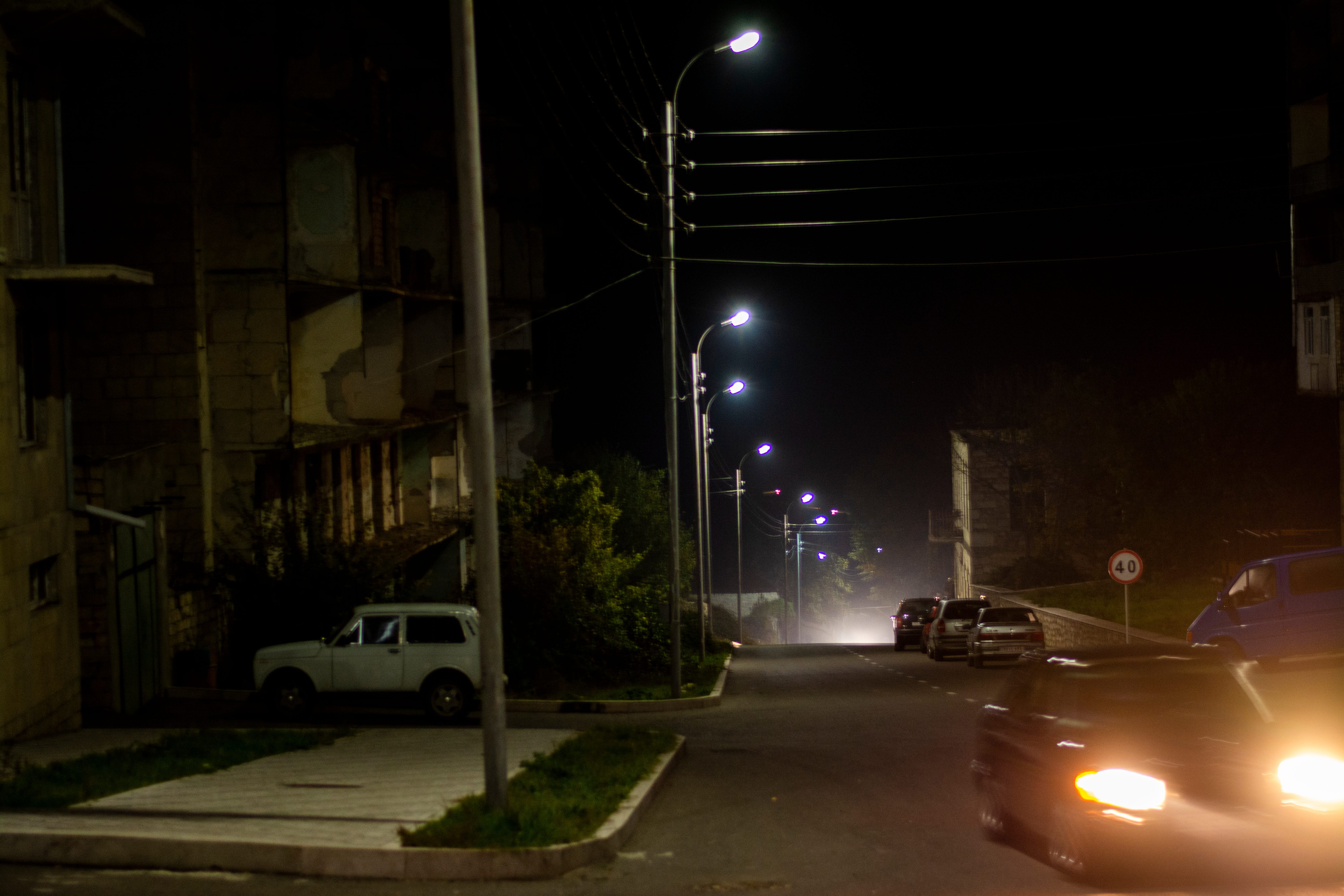
“Come on, come on,” Milena said as she held George’s head while he vomited. She’d never seen vomit so red before. “Let it all out,” she added. After a few purges, George laughed; he felt clean now, and his throat no longer buzzed with anger. He could not remember how he’d gotten here in the middle of the street. He rubbed his mouth and looked down at the vomit as it slowly dribbled down the road that had earlier caused him so much grief. “Serves you right,” he mumbled. “Serves you all right,” he repeated with mocking laughter. He stumbled onto the road, making a few paces, keeping himself upright by leaning on an old grey Lada Niva. He looked up at the street lights, which were tall and too shy to light up the nude concrete buildings that were now only skeletons of the apartments they once were. A breeze made the streets sway, made the powerlines dance with joy. He could taste the oxidation on his lips. “Soviet times,” he mumbled.
“I’ve never seen you this drunk before, it’s funny,” Milena yelped as she came up behind George, shoving him, holding onto his arms to stop him from falling. “Look,” she said. “Look at what I snuck out with me;” George watched Milena as she took out a bottle of cognac from a pocket hidden by floral patterns. Her skin was warm, full of blemishes from the sun and the top of her chest, exposed by a few insubordinate buttons, was slick with sweat. Was that really her? He didn’t even notice that she’d grown taller than him. George moved away and hid behind the car, undoing his zipper; “sorry, I have some construction to do.” Milena was bewildered, amused, listening to the pitter-patter of George’s piss. “Is this how they are in Moscow?” she sang with giggles. George shook himself dry and zipped up. “It is,” he slurred. “They’re animals. And the girls are even worse. They piss in the street too.”
Milena laughed as she took a few gulps from the cognac bottle before handing it to George. “I’m sure,” she answered, her eyes like probing saucers. “But why did you stay there?” she asked as her smile faded. George took a few gulps of the cognac, surprised that it now soothed him. George couldn’t look her in the eyes. “I didn’t want to come home,” he answered. Milena stuck her hands into her pockets and looked up at the night sky, which was now full of solitary stars. “I’d left for the military because I didn’t want to be here. And after I lost my feet, they told me I could get better care from a specialist in Moscow. And then I just never left. I guess I’d feel like a failure if I came back.”
“Did you have like a secret wife or something? Secret Russian family,” Milena cackled. “I’m mean, probably, because you just never called,” she added. George leaned onto the Lada and looked down at his hands; despite everything, they’d remained so soft. “That’s not really how they are in Moscow. They’re not very close. I got a lot of sympathy because of my injuries thought,” George laughed, wanting to sound wistful somehow. Milena came closer and touched George’s hand. “But when I heard about it, I really cried—” she said, George could smell her; like fresh clay. “I was so upset, George. I mean, you’re like an older brother to me, you know.” He thought of being honest with her somehow— of telling her how difficult it feels to be unwanted.
Milena’s face started to swell. He looked up at her. With his hand, he brushed away from of her hair; black, the ends thick like straw. She had deep, severe eyes; ‘round them, a circle of coal that reminded him of scorched earth. He grabbed her by the arms, she was pliant as he held her in place; he shut his eyes and he kissed her, enjoyed how she twitched ever so slightly under his grasp. Her lips were plump, tasting of grass somehow. When he opened his eyes, he saw her staring at him, wide-eyes, wearing an expression of fear he’d never seen before.
“I’m sorry, I—,” George said, unsure of what more he would say. Milena took George’s hands with her own hands, pressed them together, the four of them a rigid barricade ‘tween them. “It’s okay, George,” Milena muttered. She suddenly seemed so sad, as if the pieces of something she’d deeply cherished had been placed into her hands. “I know you had a lot to drink. I did too. I’m just glad you’re home,” she said with a troubled smile. “I know it must have been hard to be alone.” George wondered if she was even curious about who he’d imagined kissing. “Yeah, I’m just glad you’re home. And we should go back,” she added. “Your mother and her friends are all probably waiting for us.”
When George and Milena returned, the garden was mostly empty of people, except for a few sleeping drunks, snoring away their sorrows as the night air grew sweet to the touch. Milena pointed ‘twards the house and they walked together to the door without exchanging words. George stood at the door, his hand on the knob, but something stopped him from turning. He couldn’t explain it. Milena looked at him; she pushed him aside and opened the door for him, and she waited for him to walk through.
In the kitchen, George found his mother and a few of her friends, standing beside Hmayak. Hmayak was an old family friend, a sinewy man dressed in camouflage with a glass eye. As a child, he would frighten George with stories of how shrapnel felt as it entered your flesh; hot and somehow cool at the same time. When Lilit saw George standing by the door, with Milena behind him, she smiled and approached him. She reached for his hand and squeezed it. “I know, I know; I wasn’t going to say anything,” she whispered to him. She’d said that about crying when he’d arrived. She’d said that about his injury when she’d called him in Moscow. She’d said that about his father’s death when he was brought back from the border. Everything seemed to hang upon what we’ve promised not to say. And she took her son by the arm, and she poured everyone a few sips of fine cognac she’d saved for his return.
“Milena, have some too! For the hero’s return,” Lilit bellowed as she shoved an ornate little glass stakanchik into Milena’s hand, letting a few drops of brandy spill onto the wooden floors as she poured. Hmayak nodded with a rigid smile and stood up from his seat, clearing his throat before speaking with a few sips. Beside him, Angelika and Hasmik raised their glasses to Milena, as if to welcome her.
“My boy,” Hmayak’s voice sounded like gravel, “Lilit and we— well, we wanted to give you a hero’s return.” He straightened his back, becoming taut like a bird of prey. George imagined Hmayak practicing in the mirror of his barracks, smiling as he thought of returning triumphant to speeches and toasts.
George raised his glass, unsure of how a hero should respond. “Thank you, but—” he looked at everyone’s faces as they stared at him; they seemed to expect something from him, but they were cruel and would not tell him what it was. “But, I’m really not a hero at all. I just did what was expected of me.”
Hmayak laughed, putting everyone at ease by returning their searching glances. “He’s modest.” And everyone laughed along to Hmayak as if he’d told a joke. “To the hero!” Hmayak shouted. He took a gulp of the cognac, and everyone else followed along, including Milena who started to wheeze and cough as it went down her throat all crude.
“Now stop me if I toast too long like always,” Hmayak said as Lilit filled everyone’s glasses once more. “But I wanted to say something to you. To everyone here.” He adjusted his sweater, he put his hand in his pocket, he stood at attention.
“I wanted to say that though we’ve all suffered a great defeat, we should always remember that we are Armenians. We are a proud people. We are the descendants of kings and queens, Aram and Sosem. We’ve overcome much this last century, and this century as well, and we’ll have so much more to overcome— but we will overcome. And I know if your father was here, he’d be so proud of you. For being a man, even when they took your health away from you.”
Lilit took her son’s hand in her own, squeezing it tightly as a few tears rolled down her cheek. George looked back at Milena; the troubled lines on her face made hers seem suddenly so worn, cracks forming in her face as if some great weight had been set upon her. She looked down, into the surface of her drink, searching for her own reflection. And he looked at all the people in the room; he envied how their eyes glittered with rapture.
“I know what you’ve gone through. I wanted to tell you that I’ve gone through the same thing. So did your father. And while I made it through, your father did not; GOD rest his soul. Losing him was a terrible tragedy; for me, for your mother, for you. But we will overcome. We will overcome because that’s what we do. That’s what it means to be an Armenian. It means to overcome, to be strong no matter what we face. And we face it together.” Hmayak’s face started to turn the shade of blood, and Lilit jumped up to hand him a tissue which Hmayak used to dry his eyes.
“I’m sorry. An old man gets sentimental in his age. I just wanted to say that it fills me with pride to see that you’ve given so much to your fatherland, just as I’ve given so much, more than I thought I could give.” Hmayak pointed to his glass eye and smiles. “But that’s what it means to be a man, an Armenian man. It means to give, to give more than you thought you could give. To give just as I did, as your father did, and expect nothing in return— nothing but the comfort of knowing that you’ve served our fatherland and our people.”
And as everyone rubbed their tired eyes, Hmayak raised his glass and smiled. “This is to the next generation of Armenia. Proud warriors, and citizens of the world.” He motioned at Milena, beckoning George to follow his gaze. “And it’s your responsibility now to father the next generations of Armenians. To father the next generation of heroes. So here’s a toast to you, our hero!” Milena smiled, her eyes turning red as Lilit stopped her from covering her eyes with her hands. And as they all raised their glasses, in honor of the great hero’s return, they looked at George once more as if expecting something from him. George tried to think of a few words to say but he couldn’t think of anything. He started to cry.